MoreExam
1. Question Content...
EXPLANATION
Answer: X - EXPLANATION Content.
Question1: You are training a Resnet model on Al Platform using TPUs to visually categorize types of defects in automobile engines. You capture the training profile using the Cloud TPU profiler plugin and observe that it is highly input-bound. You want to reduce the bottleneck and speed up your model training process. Which modifications should you make to the tf .data dataset?Choose 2 answers
Question2: A company is using Amazon Textract to extract textual data from thousands of scanned text-heavy legal documents daily. The company uses this information to process loan applications automatically. Some of the documents fail business validation and are returned to human reviewers, who investigate the errors. This activity increases the time to process the loan applications.What should the company do to reduce the processing time of loan applications?
Question3: You work for a toy manufacturer that has been experiencing a large increase in demand. You need to build an ML model to reduce the amount of time spent by quality control inspectors checking for product defects. Faster defect detection is a priority. The factory does not have reliable Wi-Fi. Your company wants to implement the new ML model as soon as possible. Which model should you use?
Question4: You work for an online publisher that delivers news articles to over 50 million readers. You have built an AI model that recommends content for the company's weekly newsletter. A recommendation is considered successful if the article is opened within two days of the newsletter's published date and the user remains on the page for at least one minute.All the information needed to compute the success metric is available in BigQuery and is updated hourly. The model is trained on eight weeks of data, on average its performance degrades below the acceptable baseline after five weeks, and training time is 12 hours. You want to ensure that the model's performance is above the acceptable baseline while minimizing cost. How should you monitor the model to determine when retraining is necessary?
Question5: A monitoring service generates 1 TB of scale metrics record data every minute. A Research team performs queries on this data using Amazon Athena. The queries run slowly due to the large volume of data, and the team requires better performance.How should the records be stored in Amazon S3 to improve query performance?
Question6: A Data Science team is designing a dataset repository where it will store a large amount of training data commonly used in its machine learning models. As Data Scientists may create an arbitrary number of new datasets every day, the solution has to scale automatically and be cost-effective. Also, it must be possible to explore the data using SQL.Which storage scheme is MOST adapted to this scenario?
Question7: You are an ML engineer at a bank that has a mobile application. Management has asked you to build an ML-based biometric authentication for the app that verifies a customer's identity based on their fingerprint. Fingerprints are considered highly sensitive personal information and cannot be downloaded and stored into the bank databases. Which learning strategy should you recommend to train and deploy this ML model?
Question8: You are experimenting with a built-in distributed XGBoost model in Vertex AI Workbench user-managed notebooks. You use BigQuery to split your data into training and validation sets using the following queries:CREATE OR REPLACE TABLE 'myproject.mydataset.training' AS(SELECT * FROM 'myproject.mydataset.mytable' WHERE RAND() <= 0.8);CREATE OR REPLACE TABLE 'myproject.mydataset.validation' AS(SELECT * FROM 'myproject.mydataset.mytable' WHERE RAND() <= 0.2);After training the model, you achieve an area under the receiver operating characteristic curve (AUC ROC) value of 0.8, but after deploying the model to production, you notice that your model performance has dropped to an AUC ROC value of 0.65. What problem is most likely occurring?
Question9: Your data science team is training a PyTorch model for image classification based on a pre-trained RestNet model. You need to perform hyperparameter tuning to optimize for several parameters. What should you do?
Question10: You are an ML engineer at a manufacturing company. You need to build a model that identifies defects in products based on images of the product taken at the end of the assembly line. You want your model to preprocess the images with lower computation to quickly extract features of defects in products. Which approach should you use to build the model?
Question11: You work for a company that provides an anti-spam service that flags and hides spam posts on social media platforms. Your company currently uses a list of 200,000 keywords to identify suspected spam posts. If a post contains more than a few of these keywords, the post is identified as spam. You want to start using machine learning to flag spam posts for human review. What is the main advantage of implementing machine learning for this business case?
Question12: You are building a model to predict daily temperatures. You split the data randomly and then transformed the training and test datasets. Temperature data for model training is uploaded hourly. During testing, your model performed with 97% accuracy; however, after deploying to production, the model's accuracy dropped to 66%. How can you make your production model more accurate?
Question13: You work as an ML engineer at a social media company, and you are developing a visual filter for users' profile photos. This requires you to train an ML model to detect bounding boxes around human faces. You want to use this filter in your company's iOS-based mobile phone application. You want to minimize code development and want the model to be optimized for inference on mobile phones. What should you do?
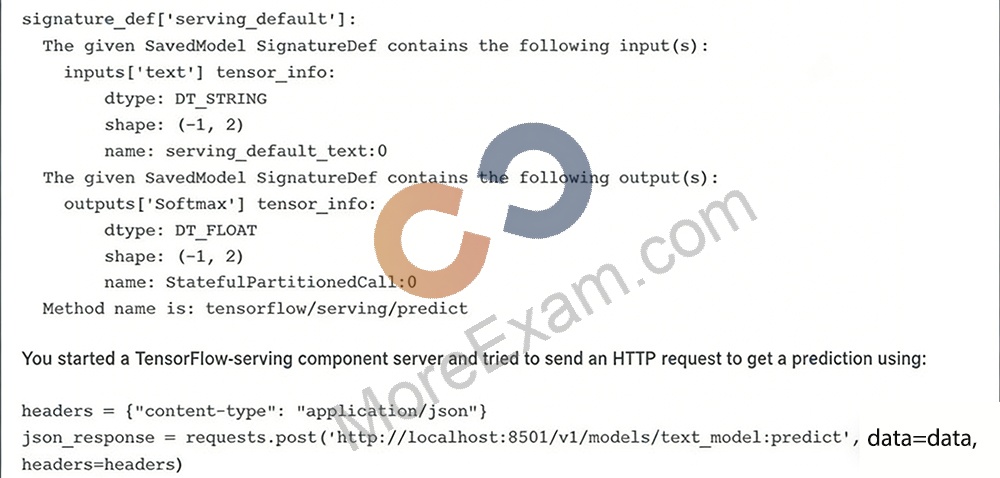
Question14: You trained a text classification model. You have the following SignatureDefs:What is the correct way to write the predict request?
Question15: You are training a Resnet model on Al Platform using TPUs to visually categorize types of defects in automobile engines. You capture the training profile using the Cloud TPU profiler plugin and observe that it is highly input-bound. You want to reduce the bottleneck and speed up your model training process. Which modifications should you make to the tf .data dataset?Choose 2 answers
Question16: You developed an ML model with Al Platform, and you want to move it to production. You serve a few thousand queries per second and are experiencing latency issues. Incoming requests are served by a load balancer that distributes them across multiple Kubeflow CPU-only pods running on Google Kubernetes Engine (GKE). Your goal is to improve the serving latency without changing the underlying infrastructure. What should you do?
Question17: You have trained a model on a dataset that required computationally expensive preprocessing operations. You need to execute the same preprocessing at prediction time. You deployed the model on Al Platform for high-throughput online prediction. Which architecture should you use?
Question18: You work for a company that manages a ticketing platform for a large chain of cinemas. Customers use a mobile app to search for movies they're interested in and purchase tickets in the app. Ticket purchase requests are sent to Pub/Sub and are processed with a Dataflow streaming pipeline configured to conduct the following steps:1. Check for availability of the movie tickets at the selected cinema.2. Assign the ticket price and accept payment.3. Reserve the tickets at the selected cinema.4. Send successful purchases to your database.Each step in this process has low latency requirements (less than 50 milliseconds). You have developed a logistic regression model with BigQuery ML that predicts whether offering a promo code for free popcorn increases the chance of a ticket purchase, and this prediction should be added to the ticket purchase process. You want to identify the simplest way to deploy this model to production while adding minimal latency. What should you do?
Question19: You work for a large technology company that wants to modernize their contact center. You have been asked to develop a solution to classify incoming calls by product so that requests can be more quickly routed to the correct support team. You have already transcribed the calls using the Speech-to-Text API. You want to minimize data preprocessing and development time. How should you build the model?
Question20: As the lead ML Engineer for your company, you are responsible for building ML models to digitize scanned customer forms. You have developed a TensorFlow model that converts the scanned images into text and stores them in Cloud Storage. You need to use your ML model on the aggregated data collected at the end of each day with minimal manual intervention. What should you do?
Question21: You are a data scientist at an industrial equipment manufacturing company. You are developing a regression model to estimate the power consumption in the company's manufacturing plants based on sensor data collected from all of the plants. The sensors collect tens of millions of records every day. You need to schedule daily training runs for your model that use all the data collected up to the current date. You want your model to scale smoothly and require minimal development work. What should you do?
Question22: You are working on a Neural Network-based project. The dataset provided to you has columns with different ranges. While preparing the data for model training, you discover that gradient optimization is having difficulty moving weights to a good solution. What should you do?
Question23: You work for a gaming company that has millions of customers around the world. All games offer a chat feature that allows players to communicate with each other in real time. Messages can be typed in more than 20 languages and are translated in real time using the Cloud Translation API. You have been asked to build an ML system to moderate the chat in real time while assuring that the performance is uniform across the various languages and without changing the serving infrastructure.You trained your first model using an in-house word2vec model for embedding the chat messages translated by the Cloud Translation API. However, the model has significant differences in performance across the different languages. How should you improve it?
Question24: You work for a company that is developing a new video streaming platform. You have been asked to create a recommendation system that will suggest the next video for a user to watch. After a review by an AI Ethics team, you are approved to start development. Each video asset in your company's catalog has useful metadata (e.g., content type, release date, country), but you do not have any historical user event dat a. How should you build the recommendation system for the first version of the product?
Question25: A Machine Learning Specialist is working with a large cybersecurity company that manages security events in real time for companies around the world. The cybersecurity company wants to design a solution that will allow it to use machine learning to score malicious events as anomalies on the data as it is being ingested. The company also wants be able to save the results in its data lake for later processing and analysis.What is the MOST efficient way to accomplish these tasks?
Question26: You have written unit tests for a Kubeflow Pipeline that require custom libraries. You want to automate the execution of unit tests with each new push to your development branch in Cloud Source Repositories. What should you do?
Question27: You work on the data science team at a manufacturing company. You are reviewing the company's historical sales data, which has hundreds of millions of records. For your exploratory data analysis, you need to calculate descriptive statistics such as mean, median, and mode; conduct complex statistical tests for hypothesis testing; and plot variations of the features over time You want to use as much of the sales data as possible in your analyses while minimizing computational resources. What should you do?
Question28: Your data science team needs to rapidly experiment with various features, model architectures, and hyperparameters. They need to track the accuracy metrics for various experiments and use an API to query the metrics over time. What should they use to track and report their experiments while minimizing manual effort?
Question29: An agency collects census information within a country to determine healthcare and social program needs by province and city. The census form collects responses for approximately 500 questions from each citizen.Which combination of algorithms would provide the appropriate insights? (Choose two.)
Question30: You are building a model to predict daily temperatures. You split the data randomly and then transformed the training and test datasets. Temperature data for model training is uploaded hourly. During testing, your model performed with 97% accuracy; however, after deploying to production, the model's accuracy dropped to 66%. How can you make your production model more accurate?
Question31: A Machine Learning Specialist is packaging a custom ResNet model into a Docker container so the company can leverage Amazon SageMaker for training. The Specialist is using Amazon EC2 P3 instances to train the model and needs to properly configure the Docker container to leverage the NVIDIA GPUs.What does the Specialist need to do?
Question32: A Machine Learning Specialist works for a credit card processing company and needs to predict which transactions may be fraudulent in near-real time. Specifically, the Specialist must train a model that returns the probability that a given transaction may fraudulent.How should the Specialist frame this business problem?
Question33: A Machine Learning Specialist previously trained a logistic regression model using scikit-learn on a local machine, and the Specialist now wants to deploy it to production for inference only.What steps should be taken to ensure Amazon SageMaker can host a model that was trained locally?
Question34: You are training an LSTM-based model on Al Platform to summarize text using the following job submission script:You want to ensure that training time is minimized without significantly compromising the accuracy of your model. What should you do?
Question35: A Machine Learning Specialist is preparing data for training on Amazon SageMaker. The Specialist is using one of the SageMaker built-in algorithms for the training. The dataset is stored in .CSV format and is transformed into a numpy.array, which appears to be negatively affecting the speed of the training.What should the Specialist do to optimize the data for training on SageMaker?
Question36: You recently designed and built a custom neural network that uses critical dependencies specific to your organization's framework. You need to train the model using a managed training service on Google Cloud. However, the ML framework and related dependencies are not supported by Al Platform Training. Also, both your model and your data are too large to fit in memory on a single machine. Your ML framework of choice uses the scheduler, workers, and servers distribution structure. What should you do?
Question37: You work for a public transportation company and need to build a model to estimate delay times for multiple transportation routes. Predictions are served directly to users in an app in real time. Because different seasons and population increases impact the data relevance, you will retrain the model every month. You want to follow Google-recommended best practices. How should you configure the end-to-end architecture of the predictive model?
Question38: A Machine Learning Specialist receives customer data for an online shopping website. The data includes demographics, past visits, and locality information. The Specialist must develop a machine learning approach to identify the customer shopping patterns, preferences, and trends to enhance the website for better service and smart recommendations.Which solution should the Specialist recommend?
Question39: You are designing an ML recommendation model for shoppers on your company's ecommerce website. You will use Recommendations Al to build, test, and deploy your system. How should you develop recommendations that increase revenue while following best practices?
Question40: You have written unit tests for a Kubeflow Pipeline that require custom libraries. You want to automate the execution of unit tests with each new push to your development branch in Cloud Source Repositories. What should you do?
Question41: You work for a global footwear retailer and need to predict when an item will be out of stock based on historical inventory dat a. Customer behavior is highly dynamic since footwear demand is influenced by many different factors. You want to serve models that are trained on all available data, but track your performance on specific subsets of data before pushing to production. What is the most streamlined and reliable way to perform this validation?
Question42: You are an ML engineer at a travel company. You have been researching customers' travel behavior for many years, and you have deployed models that predict customers' vacation patterns. You have observed that customers' vacation destinations vary based on seasonality and holidays; however, these seasonal variations are similar across years. You want to quickly and easily store and compare the model versions and performance statistics across years. What should you do?
Question43: You work with a data engineering team that has developed a pipeline to clean your dataset and save it in a Cloud Storage bucket. You have created an ML model and want to use the data to refresh your model as soon as new data is available. As part of your CI/CD workflow, you want to automatically run a Kubeflow Pipelines training job on Google Kubernetes Engine (GKE). How should you architect this workflow?
Question44: You were asked to investigate failures of a production line component based on sensor readings. After receiving the dataset, you discover that less than 1% of the readings are positive examples representing failure incidents. You have tried to train several classification models, but none of them converge. How should you resolve the class imbalance problem?
Question45: You are experimenting with a built-in distributed XGBoost model in Vertex AI Workbench user-managed notebooks. You use BigQuery to split your data into training and validation sets using the following queries:CREATE OR REPLACE TABLE 'myproject.mydataset.training' AS(SELECT * FROM 'myproject.mydataset.mytable' WHERE RAND() <= 0.8);CREATE OR REPLACE TABLE 'myproject.mydataset.validation' AS(SELECT * FROM 'myproject.mydataset.mytable' WHERE RAND() <= 0.2);After training the model, you achieve an area under the receiver operating characteristic curve (AUC ROC) value of 0.8, but after deploying the model to production, you notice that your model performance has dropped to an AUC ROC value of 0.65. What problem is most likely occurring?
Question46: Your team needs to build a model that predicts whether images contain a driver's license, passport, or credit card. The data engineering team already built the pipeline and generated a dataset composed of 10,000 images with driver's licenses, 1,000 images with passports, and 1,000 images with credit cards. You now have to train a model with the following label map: ['driversjicense', 'passport', 'credit_card']. Which loss function should you use?
Question47: A Data Scientist needs to migrate an existing on-premises ETL process to the cloud. The current process runs at regular time intervals and uses PySpark to combine and format multiple large data sources into a single consolidated output for downstream processing.The Data Scientist has been given the following requirements to the cloud solution:* Combine multiple data sources.* Reuse existing PySpark logic.* Run the solution on the existing schedule.* Minimize the number of servers that will need to be managed.Which architecture should the Data Scientist use to build this solution?
Question48: You have a functioning end-to-end ML pipeline that involves tuning the hyperparameters of your ML model using Al Platform, and then using the best-tuned parameters for training. Hypertuning is taking longer than expected and is delaying the downstream processes. You want to speed up the tuning job without significantly compromising its effectiveness. Which actions should you take?Choose 2 answers
Question49: Your organization's call center has asked you to develop a model that analyzes customer sentiments in each call. The call center receives over one million calls daily, and data is stored in Cloud Storage. The data collected must not leave the region in which the call originated, and no Personally Identifiable Information (Pll) can be stored or analyzed. The data science team has a third-party tool for visualization and access which requires a SQL ANSI-2011 compliant interface. You need to select components for data processing and for analytics. How should the data pipeline be designed?
Question50: You work for a large hotel chain and have been asked to assist the marketing team in gathering predictions for a targeted marketing strategy. You need to make predictions about user lifetime value (LTV) over the next 30 days so that marketing can be adjusted accordingly. The customer dataset is in BigQuery, and you are preparing the tabular data for training with AutoML Tables. This data has a time signal that is spread across multiple columns. How should you ensure that AutoML fits the best model to your data?
Question51: A financial services company is building a robust serverless data lake on Amazon S3. The data lake should be flexible and meet the following requirements:* Support querying old and new data on Amazon S3 through Amazon Athena and Amazon Redshift Spectrum.* Support event-driven ETL pipelines* Provide a quick and easy way to understand metadataWhich approach meets these requirements?
Question52: During batch training of a neural network, you notice that there is an oscillation in the loss. How should you adjust your model to ensure that it converges?
Question53: A Machine Learning Specialist is designing a system for improving sales for a company. The objective is to use the large amount of information the company has on users' behavior and product preferences to predict which products users would like based on the users' similarity to other users.What should the Specialist do to meet this objective?
Question54: Your company manages a video sharing website where users can watch and upload videos. You need to create an ML model to predict which newly uploaded videos will be the most popular so that those videos can be prioritized on your company's website.Which result should you use to determine whether the model is successful?
Question55: You work for a public transportation company and need to build a model to estimate delay times for multiple transportation routes. Predictions are served directly to users in an app in real time. Because different seasons and population increases impact the data relevance, you will retrain the model every month. You want to follow Google-recommended best practices. How should you configure the end-to-end architecture of the predictive model?
Question56: You have been asked to develop an input pipeline for an ML training model that processes images from disparate sources at a low latency. You discover that your input data does not fit in memory. How should you create a dataset following Google-recommended best practices?
Question57: You need to train a regression model based on a dataset containing 50,000 records that is stored in BigQuery. The data includes a total of 20 categorical and numerical features with a target variable that can include negative values. You need to minimize effort and training time while maximizing model performance. What approach should you take to train this regression model?
Question58: You work for an advertising company and want to understand the effectiveness of your company's latest advertising campaign. You have streamed 500 MB of campaign data into BigQuery. You want to query the table, and then manipulate the results of that query with a pandas dataframe in an Al Platform notebook. What should you do?
Question59: A Machine Learning Specialist is given a structured dataset on the shopping habits of a company's customer base. The dataset contains thousands of columns of data and hundreds of numerical columns for each customer. The Specialist wants to identify whether there are natural groupings for these columns across all customers and visualize the results as quickly as possible.What approach should the Specialist take to accomplish these tasks?
Question60: You are working on a classification problem with time series data and achieved an area under the receiver operating characteristic curve (AUC ROC) value of 99% for training data after just a few experiments. You haven't explored using any sophisticated algorithms or spent any time on hyperparameter tuning. What should your next step be to identify and fix the problem?
Question61: Your team is building an application for a global bank that will be used by millions of customers. You built a forecasting model that predicts customers1 account balances 3 days in the future. Your team will use the results in a new feature that will notify users when their account balance is likely to drop below $25. How should you serve your predictions?
Question62: Your team needs to build a model that predicts whether images contain a driver's license, passport, or credit card. The data engineering team already built the pipeline and generated a dataset composed of 10,000 images with driver's licenses, 1,000 images with passports, and 1,000 images with credit cards. You now have to train a model with the following label map: ['driversjicense', 'passport', 'credit_card']. Which loss function should you use?
Question63: You are developing ML models with Al Platform for image segmentation on CT scans. You frequently update your model architectures based on the newest available research papers, and have to rerun training on the same dataset to benchmark their performance. You want to minimize computation costs and manual intervention while having version control for your code. What should you do?
Question64: Your team is working on an NLP research project to predict political affiliation of authors based on articles they have written. You have a large training dataset that is structured like this:You followed the standard 80%-10%-10% data distribution across the training, testing, and evaluation subsets. How should you distribute the training examples across the train-test-eval subsets while maintaining the 80-10-10 proportion?A)B)C)D)
Question65: You work on a data science team at a bank and are creating an ML model to predict loan default risk. You have collected and cleaned hundreds of millions of records worth of training data in a BigQuery table, and you now want to develop and compare multiple models on this data using TensorFlow and Vertex AI. You want to minimize any bottlenecks during the data ingestion state while considering scalability. What should you do?
Question66: A Data Scientist wants to gain real-time insights into a data stream of GZIP files.Which solution would allow the use of SQL to query the stream with the LEAST latency?
Question67: You are training an LSTM-based model on Al Platform to summarize text using the following job submission script:You want to ensure that training time is minimized without significantly compromising the accuracy of your model. What should you do?
Question68: During batch training of a neural network, you notice that there is an oscillation in the loss. How should you adjust your model to ensure that it converges?
Question69: You recently designed and built a custom neural network that uses critical dependencies specific to your organization's framework. You need to train the model using a managed training service on Google Cloud. However, the ML framework and related dependencies are not supported by Al Platform Training. Also, both your model and your data are too large to fit in memory on a single machine. Your ML framework of choice uses the scheduler, workers, and servers distribution structure. What should you do?
Question70: You work for a large social network service provider whose users post articles and discuss news. Millions of comments are posted online each day, and more than 200 human moderators constantly review comments and flag those that are inappropriate. Your team is building an ML model to help human moderators check content on the platform. The model scores each comment and flags suspicious comments to be reviewed by a human. Which metric(s) should you use to monitor the model's performance?
Question71: You have been asked to develop an input pipeline for an ML training model that processes images from disparate sources at a low latency. You discover that your input data does not fit in memory. How should you create a dataset following Google-recommended best practices?
Question72: You work for a social media company. You need to detect whether posted images contain cars. Each training example is a member of exactly one class. You have trained an object detection neural network and deployed the model version to Al Platform Prediction for evaluation. Before deployment, you created an evaluation job and attached it to the Al Platform Prediction model version. You notice that the precision is lower than your business requirements allow. How should you adjust the model's final layer softmax threshold to increase precision?
Question73: A Machine Learning Specialist kicks off a hyperparameter tuning job for a tree-based ensemble model using Amazon SageMaker with Area Under the ROC Curve (AUC) as the objective metric. This workflow will eventually be deployed in a pipeline that retrains and tunes hyperparameters each night to model click-through on data that goes stale every 24 hours.With the goal of decreasing the amount of time it takes to train these models, and ultimately to decrease costs, the Specialist wants to reconfigure the input hyperparameter range(s).Which visualization will accomplish this?
Question74: A Data Scientist is developing a machine learning model to predict future patient outcomes based on information collected about each patient and their treatment plans. The model should output a continuous value as its prediction. The data available includes labeled outcomes for a set of 4,000 patients. The study was conducted on a group of individuals over the age of 65 who have a particular disease that is known to worsen with age.Initial models have performed poorly. While reviewing the underlying data, the Data Scientist notices that, out of 4,000 patient observations, there are 450 where the patient age has been input as 0. The other features for these observations appear normal compared to the rest of the sample population How should the Data Scientist correct this issue?
Question75: A retail company is using Amazon Personalize to provide personalized product recommendations for its customers during a marketing campaign. The company sees a significant increase in sales of recommended items to existing customers immediately after deploying a new solution version, but these sales decrease a short time after deployment. Only historical data from before the marketing campaign is available for training.How should a data scientist adjust the solution?
Question76: You are building a real-time prediction engine that streams files which may contain Personally Identifiable Information (Pll) to Google Cloud. You want to use the Cloud Data Loss Prevention (DLP) API to scan the files. How should you ensure that the Pll is not accessible by unauthorized individuals?
Question77: A Machine Learning Specialist uploads a dataset to an Amazon S3 bucket protected with server-side encryption using AWS KMS.How should the ML Specialist define the Amazon SageMaker notebook instance so it can read the same dataset from Amazon S3?
Question78: A Data Engineer needs to build a model using a dataset containing customer credit card information How can the Data Engineer ensure the data remains encrypted and the credit card information is secure?
Question79: Machine Learning Specialist is building a model to predict future employment rates based on a wide range of economic factors. While exploring the data, the Specialist notices that the magnitude of the input features vary greatly. The Specialist does not want variables with a larger magnitude to dominate the model.What should the Specialist do to prepare the data for model training?
Question80: You work for an online publisher that delivers news articles to over 50 million readers. You have built an AI model that recommends content for the company's weekly newsletter. A recommendation is considered successful if the article is opened within two days of the newsletter's published date and the user remains on the page for at least one minute.All the information needed to compute the success metric is available in BigQuery and is updated hourly. The model is trained on eight weeks of data, on average its performance degrades below the acceptable baseline after five weeks, and training time is 12 hours. You want to ensure that the model's performance is above the acceptable baseline while minimizing cost. How should you monitor the model to determine when retraining is necessary?
Question81: You work with a data engineering team that has developed a pipeline to clean your dataset and save it in a Cloud Storage bucket. You have created an ML model and want to use the data to refresh your model as soon as new data is available. As part of your CI/CD workflow, you want to automatically run a Kubeflow Pipelines training job on Google Kubernetes Engine (GKE). How should you architect this workflow?
Question82: A Machine Learning Specialist at a company sensitive to security is preparing a dataset for model training. The dataset is stored in Amazon S3 and contains Personally Identifiable Information (PII).The dataset:* Must be accessible from a VPC only.* Must not traverse the public internet.How can these requirements be satisfied?
Question83: A Data Science team within a large company uses Amazon SageMaker notebooks to access data stored in Amazon S3 buckets. The IT Security team is concerned that internet-enabled notebook instances create a security vulnerability where malicious code running on the instances could compromise data privacy. The company mandates that all instances stay within a secured VPC with no internet access, and data communication traffic must stay within the AWS network.How should the Data Science team configure the notebook instance placement to meet these requirements?
Question84: You are developing models to classify customer support emails. You created models with TensorFlow Estimators using small datasets on your on-premises system, but you now need to train the models using large datasets to ensure high performance. You will port your models to Google Cloud and want to minimize code refactoring and infrastructure overhead for easier migration from on-prem to cloud. What should you do?
Question85: A Marketing Manager at a pet insurance company plans to launch a targeted marketing campaign on social media to acquire new customers. Currently, the company has the following data in Amazon Aurora:* Profiles for all past and existing customers* Profiles for all past and existing insured pets* Policy-level information* Premiums received* Claims paidWhat steps should be taken to implement a machine learning model to identify potential new customers on social media?
Question86: You are building a linear regression model on BigQuery ML to predict a customer's likelihood of purchasing your company's products. Your model uses a city name variable as a key predictive component. In order to train and serve the model, your data must be organized in columns. You want to prepare your data using the least amount of coding while maintaining the predictable variables. What should you do?
Question87: You work for a bank and are building a random forest model for fraud detection. You have a dataset that includes transactions, of which 1% are identified as fraudulent.Which data transformation strategy would likely improve the performance of your classifier?
Question88: Your data science team has requested a system that supports scheduled model retraining, Docker containers, and a service that supports autoscaling and monitoring for online prediction requests. Which platform components should you choose for this system?
Question89: You are developing models to classify customer support emails. You created models with TensorFlow Estimators using small datasets on your on-premises system, but you now need to train the models using large datasets to ensure high performance. You will port your models to Google Cloud and want to minimize code refactoring and infrastructure overhead for easier migration from on-prem to cloud. What should you do?
Question90: You are going to train a DNN regression model with Keras APIs using this code:How many trainable weights does your model have? (The arithmetic below is correct.)
Question91: A data scientist wants to use Amazon Forecast to build a forecasting model for inventory demand for a retail company. The company has provided a dataset of historic inventory demand for its products as a .csv file stored in an Amazon S3 bucket. The table below shows a sample of the dataset.How should the data scientist transform the data?
Question92: Your team is working on an NLP research project to predict political affiliation of authors based on articles they have written. You have a large training dataset that is structured like this:A)B)C)D)
Question93: A manufacturing company has a large set of labeled historical sales data. The manufacturer would like to predict how many units of a particular part should be produced each quarter.Which machine learning approach should be used to solve this problem?
Question94: You are an ML engineer in the contact center of a large enterprise. You need to build a sentiment analysis tool that predicts customer sentiment from recorded phone conversations. You need to identify the best approach to building a model while ensuring that the gender, age, and cultural differences of the customers who called the contact center do not impact any stage of the model development pipeline and results. What should you do?
Question95: A Machine Learning Specialist is developing a daily ETL workflow containing multiple ETL jobs. The workflow consists of the following processes:* Start the workflow as soon as data is uploaded to Amazon S3.* When all the datasets are available in Amazon S3, start an ETL job to join the uploaded datasets with multiple terabyte-sized datasets already stored in Amazon S3.* Store the results of joining datasets in Amazon S3.* If one of the jobs fails, send a notification to the Administrator.Which configuration will meet these requirements?
Question96: You are an ML engineer at a global car manufacturer. You need to build an ML model to predict car sales in different cities around the world. Which features or feature crosses should you use to train city-specific relationships between car type and number of sales?
Question97: You work with a data engineering team that has developed a pipeline to clean your dataset and save it in a Cloud Storage bucket. You have created an ML model and want to use the data to refresh your model as soon as new data is available. As part of your CI/CD workflow, you want to automatically run a Kubeflow Pipelines training job on Google Kubernetes Engine (GKE). How should you architect this workflow?
Question98: A Machine Learning Specialist working for an online fashion company wants to build a data ingestion solution for the company's Amazon S3-based data lake.The Specialist wants to create a set of ingestion mechanisms that will enable future capabilities comprised of:* Real-time analytics* Interactive analytics of historical data* Clickstream analytics* Product recommendationsWhich services should the Specialist use?
Question99: A Data Science team within a large company uses Amazon SageMaker notebooks to access data stored in Amazon S3 buckets. The IT Security team is concerned that internet-enabled notebook instances create a security vulnerability where malicious code running on the instances could compromise data privacy. The company mandates that all instances stay within a secured VPC with no internet access, and data communication traffic must stay within the AWS network.How should the Data Science team configure the notebook instance placement to meet these requirements?
Question100: A Machine Learning Specialist at a company sensitive to security is preparing a dataset for model training. The dataset is stored in Amazon S3 and contains Personally Identifiable Information (PII).The dataset:* Must be accessible from a VPC only.* Must not traverse the public internet.How can these requirements be satisfied?
Question101: Your data science team has requested a system that supports scheduled model retraining, Docker containers, and a service that supports autoscaling and monitoring for online prediction requests. Which platform components should you choose for this system?
Question102: You need to build an ML model for a social media application to predict whether a user's submitted profile photo meets the requirements. The application will inform the user if the picture meets the requirements. How should you build a model to ensure that the application does not falsely accept a non-compliant picture?
Question103: You work for an online travel agency that also sells advertising placements on its website to other companies.You have been asked to predict the most relevant web banner that a user should see next. Security is important to your company. The model latency requirements are 300ms@p99, the inventory is thousands of web banners, and your exploratory analysis has shown that navigation context is a good predictor.You want to Implement the simplest solution. How should you configure the prediction pipeline?
Question104: You are building an ML model to detect anomalies in real-time sensor dat a. You will use Pub/Sub to handle incoming requests. You want to store the results for analytics and visualization. How should you configure the pipeline?
Question105: Your team trained and tested a DNN regression model with good results. Six months after deployment, the model is performing poorly due to a change in the distribution of the input dat a. How should you address the input differences in production?
Question106: A Machine Learning Specialist built an image classification deep learning model. However, the Specialist ran into an overfitting problem in which the training and testing accuracies were 99% and 75%, respectively.How should the Specialist address this issue and what is the reason behind it?
Question107: You have trained a deep neural network model on Google Cloud. The model has low loss on the training data, but is performing worse on the validation dat a. You want the model to be resilient to overfitting. Which strategy should you use when retraining the model?
Question108: A Data Scientist received a set of insurance records, each consisting of a record ID, the final outcome among200 categories, and the date of the final outcome. Some partial information on claim contents is also provided, but only for a few of the 200 categories. For each outcome category, there are hundreds of records distributed over the past 3 years. The Data Scientist wants to predict how many claims to expect in each category from month to month, a few months in advance.What type of machine learning model should be used?
Question109: You need to execute a batch prediction on 100 million records in a BigQuery table with a custom TensorFlow DNN regressor model, and then store the predicted results in a BigQuery table. You want to minimize the effort required to build this inference pipeline. What should you do?
Question110: A company ingests machine learning (ML) data from web advertising clicks into an Amazon S3 data lake. Click data is added to an Amazon Kinesis data stream by using the Kinesis Producer Library (KPL). The data is loaded into the S3 data lake from the data stream by using an Amazon Kinesis Data Firehose delivery stream.As the data volume increases, an ML specialist notices that the rate of data ingested into Amazon S3 is relatively constant. There also is an increasing backlog of data for Kinesis Data Streams and Kinesis Data Firehose to ingest.Which next step is MOST likely to improve the data ingestion rate into Amazon S3?
Question111: You have a demand forecasting pipeline in production that uses Dataflow to preprocess raw data prior to model training and prediction. During preprocessing, you employ Z-score normalization on data stored in BigQuery and write it back to BigQuery. New training data is added every week. You want to make the process more efficient by minimizing computation time and manual intervention. What should you do?
Question112: A company is using Amazon Polly to translate plaintext documents to speech for automated company announcements. However, company acronyms are being mispronounced in the current documents.How should a Machine Learning Specialist address this issue for future documents?
Question113: Your company manages a video sharing website where users can watch and upload videos. You need to create an ML model to predict which newly uploaded videos will be the most popular so that those videos can be prioritized on your company's website. Which result should you use to determine whether the model is successful?
Question114: You are working on a Neural Network-based project. The dataset provided to you has columns with different ranges. While preparing the data for model training, you discover that gradient optimization is having difficulty moving weights to a good solution. What should you do?
Question115: You need to train a computer vision model that predicts the type of government ID present in a given image using a GPU-powered virtual machine on Compute Engine. You use the following parameters:* Optimizer: SGD* Image shape = 224x224* Batch size = 64* Epochs = 10* Verbose = 2During training you encounter the following error: ResourceExhaustedError: out of Memory (oom) when allocating tensor. What should you do?
Question116: You are an ML engineer at a mobile gaming company. A data scientist on your team recently trained a TensorFlow model, and you are responsible for deploying this model into a mobile application. You discover that the inference latency of the current model doesn't meet production requirements. You need to reduce the inference time by 50%, and you are willing to accept a small decrease in model accuracy in order to reach the latency requirement. Without training a new model, which model optimization technique for reducing latency should you try first?
Question117: A Mobile Network Operator is building an analytics platform to analyze and optimize a company's operations using Amazon Athena and Amazon S3.The source systems send data in .CSV format in real time. The Data Engineering team wants to transform the data to the Apache Parquet format before storing it on Amazon S3.Which solution takes the LEAST effort to implement?
Question118: You are an ML engineer at an ecommerce company and have been tasked with building a model that predicts how much inventory the logistics team should order each month. Which approach should you take?
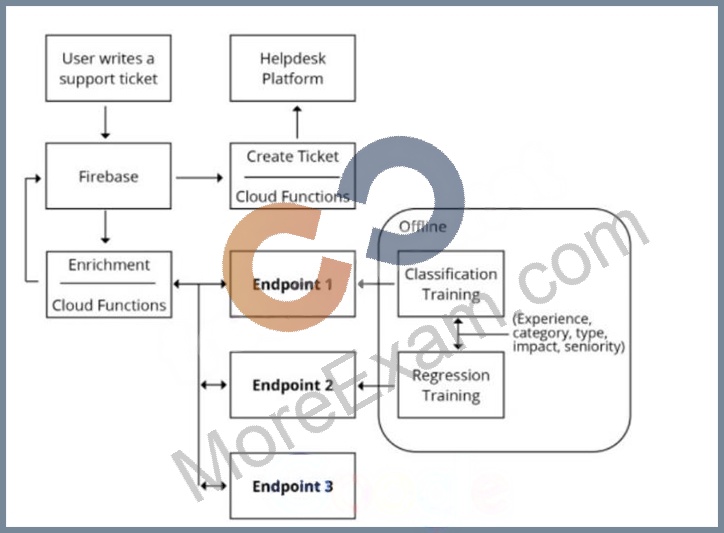
Question119: You are designing an architecture with a serveress ML system to enrich customer support tickets with informative metadata before they are routed to a support agent. You need a set of models to predict ticket priority, predict ticket resolution time, and perform sentiment analysis to help agents make strategic decisions when they process support requests. Tickets are not expected to have any domain-specific terms or jargon.The proposed architecture has the following flow:Which endpoints should the Enrichment Cloud Functions call?
Question120: You were asked to investigate failures of a production line component based on sensor readings. After receiving the dataset, you discover that less than 1% of the readings are positive examples representing failure incidents. You have tried to train several classification models, but none of them converge. How should you resolve the class imbalance problem?
Question121: You have trained a deep neural network model on Google Cloud. The model has low loss on the training data, but is performing worse on the validation dat a. You want the model to be resilient to overfitting. Which strategy should you use when retraining the model?